










The 2/3 rule for coffee tables is a simple proportion guideline: your coffee table should be roughly two-thirds the length of your sofa. So an 84 cm to 90 cm-deep sofa measuring around 210 cm long pairs well with a table close to 140 cm. The rule keeps the two pieces visually connected instead of competing, and it's one of the first checks we run through with clients at The Design House before anything gets built.
It isn't a regulation. Nobody measures your living room with a tape and issues a fine. But once you've seen it applied correctly a few times, in the right client's majlis or a well-styled show villa, you start noticing when a room is quietly working against itself, and the coffee table is usually why.
What the 2/3 Rule Actually Means
Take the length of your sofa, arm to arm, and multiply it by roughly 0.66. That number is your target coffee table length.
A 220 cm three-seater points you toward a table around 145 cm. A 180 cm loveseat points you toward something closer to 120 cm. The rule scales with the sofa, not the room, which is why it holds up whether you're furnishing a compact apartment in Business Bay or a double-height villa living room in Emirates Hills.
For round or square tables, the same logic applies to diameter or width instead of length. A round table paired with a 210 cm sofa generally looks right somewhere around 100 cm to 120 cm across.
Why Two-Thirds, Specifically
Furniture proportion follows the same instinct that shows up in art, architecture, and even how a rug should sit under a sofa's front legs. Equal-sized objects sitting side by side tend to read as accidental rather than designed. Objects with too large a size gap feel disconnected. Two-thirds sits in the middle: close enough to belong together, different enough to look intentional.
We see the same ratio recommended in our guide on coffee table and sofa pairing, and it echoes through rug sizing too. Proportion in a living room is rarely about one rule in isolation. It's a handful of ratios working together.

Sofa Length to Coffee Table Size: A Quick Reference
| Sofa Length | Target Coffee Table Length | Typical Sofa Type |
|---|---|---|
| 150–170 cm | 100–115 cm | Compact loveseat |
| 180–200 cm | 120–135 cm | Two-and-a-half seater |
| 210–230 cm | 140–155 cm | Standard three-seater |
| 240–280 cm | 160–185 cm | Large sofa or short sectional |
| 300 cm+ | Consider two smaller tables or a trio set | Sectional or modular sofa |
That last row matters more than people expect. Past around 280 cm to 300 cm of sofa length, a single table sized at two-thirds starts to feel like a runway rather than a table. This is exactly where a piece like our San Coffee Table Trio earns its place, three interlocking tables at staggered heights instead of one long slab.
Height and Clearance: The Rule's Two Quiet Partners
Length gets most of the attention, but a coffee table sized correctly can still feel wrong if the height and spacing are off.
Height: Aim to match your sofa's seat height once the cushions are compressed, or sit 2.5 cm to 5 cm lower. Most sofa seats compress to somewhere between 43 cm and 48 cm, which is why standard coffee tables cluster around 36 cm to 40 cm. We go into this in more depth in Can a Coffee Table Be Higher Than the Sofa?, including the specific scenarios where going slightly taller actually works.
Clearance: Leave 40 cm to 50 cm between the sofa and the table. Enough to walk through without a knee collision, close enough that reaching for a coffee cup doesn't require getting up.
Material and Shape Choices for Dubai Living Rooms
Dubai homes bring a few considerations that don't always show up in generic design advice.
Open-plan majlis and living areas. Many Dubai villas combine the majlis, living, and dining zones into one continuous space. When there's no wall to anchor a sofa against, the coffee table becomes one of the few fixed reference points in the room, so getting the proportion right matters even more than it would in a smaller, boxed-in layout.
Sunlight and material stability. Floor-to-ceiling windows are common in newer developments, and direct sun for several hours a day affects certain finishes. Marble and stone tops hold up well. Solid wood needs a UV-protective finish, and veneers can fade unevenly over time if positioned in direct light for years.
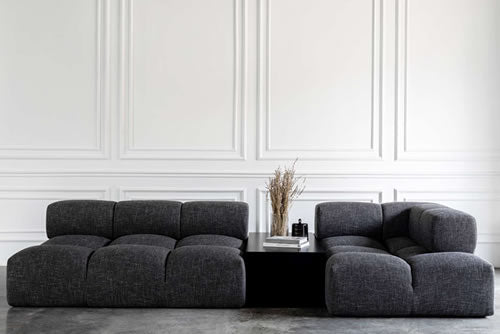
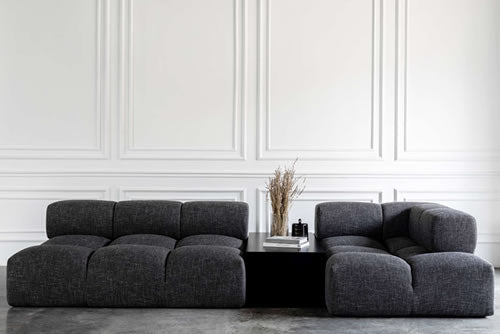
Sectional and modular sofas. L-shaped and modular layouts are popular in Dubai's larger apartments and villas, and they don't always pair neatly with a single rectangular table. Round tables, or a pair of smaller tables, tend to work better with an L-shape because they're reachable from multiple sides.
Humidity and AC cycling. Constant air conditioning creates a drier indoor environment than the outdoor humidity would suggest. Solid wood pieces benefit from a stable indoor climate and a light coat of quality furniture wax every few months to stop the material from drying out at the joints.
Common Mistakes to Avoid
- Buying the table before the sofa. Proportion only works in relation to something. Choosing a coffee table in isolation, then squeezing it in later, is one of the most common ordering mistakes we see.
- Sizing for the room instead of the sofa. A large living room doesn't automatically call for a large coffee table. The sofa is still the reference point.
- Ignoring clearance for the sake of size. A perfectly proportioned table pushed too close to the sofa still feels cramped.
- Matching height to the arm of the sofa instead of the seat. The seat cushion, compressed, is the number that matters.
- Forcing one large table onto a long sectional. Past a certain sofa length, one table stops being the answer.
When Should You Follow the 2/3 Rule Strictly?
- You're furnishing a fairly standard rectangular living room with a single sofa.
- You want the room to photograph well or feel immediately "finished" without much additional styling.
- You're working with a ready-made sofa and buying the coffee table separately.
- You're staging a property for sale or rental, where safe, proven proportions matter more than personal experimentation.
Who the Rule Isn't For
- Owners of long sectionals or modular sofas, where a trio or a pair of tables usually reads better than one oversized piece.
- Small apartments where the room's actual footprint has to take priority over the ratio.
- Anyone who has already found a coffee table they love that sits slightly outside the ratio. As long as height and clearance are respected, a room can usually absorb some flexibility on length.
- Design-forward clients deliberately playing with scale as a style statement, something we occasionally build for clients who want their coffee table to read as a sculptural piece rather than a supporting one.
Budget Guidance
Ready-made coffee tables in Dubai's mid-range retail market typically start in the low hundreds of dirhams for basic materials like MDF or laminate, moving into the low thousands for solid wood, and higher again for natural stone or marble tops.
Custom coffee tables sit at a different starting point, generally reflecting the material, the joinery, and whether the piece is a one-off or part of a matched set with a sofa. The advantage of going custom isn't just finish quality. It's that the table is built to the exact length your sofa calls for, rather than picked from whatever stock sizes happen to be available that season.
Material Comparison
| Material | Look & Feel | Durability | Best For |
|---|---|---|---|
| Solid wood | Warm, natural grain | High, with occasional care | Most living rooms, family homes |
| Marble | Substantial, luxurious | Very high, can chip at edges | Statement pieces, formal living rooms |
| Glass | Light, airy, visually forgiving | Moderate, shows fingerprints | Smaller spaces, modern interiors |
| Metal-framed | Sculptural, minimal | High | Contemporary and industrial styles |
Pros and Cons of the 2/3 Rule
| Pros | Cons |
|---|---|
| Gives a fast, reliable starting point | Doesn't account for sectional or modular sofas well |
| Backed by the same logic used in rugs and wall art | Can feel restrictive for statement or sculptural pieces |
| Easy to apply without design training | Ignores room shape and walking paths |
| Works well for staging and resale | Needs adjusting for very large or very small rooms |
A Simple Decision Framework
- Measure your sofa arm to arm.
- Multiply by roughly 0.66 to get your target coffee table length.
- Check your sofa type. Standard sofa: proceed with the number from step 2. Sectional over 280 cm: consider two tables or a trio set instead.
- Check the height. Match the compressed seat cushion height, or go 2.5–5 cm lower.
- Check the clearance. Leave 40–50 cm between sofa and table.
- Check the room, not just the sofa. If the calculated size feels too large for the walking paths in your space, size down slightly and prioritize movement.
Real-World Examples
Downtown Dubai apartment, 200 cm sofa. A rectangular sofa in an open-plan apartment called for a table around 130 cm. We paired it with a low-profile piece similar to the Marlon Coffee Table, which kept sightlines open toward the kitchen.
Emirates Hills villa, sectional sofa. A large L-shaped sectional in an open majlis-living space was too long for one table to serve comfortably. We recommended a trio arrangement instead, similar to the San Coffee Table Trio, giving the family flexibility to rearrange the surfaces depending on how many people were in the room.
FAQ
What is the 2/3 rule for coffee tables?
It's a proportion guideline stating that a coffee table should be about two-thirds the length of the sofa it sits in front of, keeping the two pieces visually balanced.
Does the 2/3 rule apply to round coffee tables?
Yes. Use the same ratio against the table's diameter instead of its length.
What if my sofa is a large sectional?
Past roughly 280 cm to 300 cm, a single table sized at two-thirds tends to look oversized. A pair of smaller tables or a multi-piece set usually works better.
How far should the coffee table be from the sofa?
Around 40 cm to 50 cm, enough for comfortable movement while keeping the table within easy reach.
Should the coffee table be the same height as the sofa?
It should generally match the sofa's compressed seat cushion height, or sit 2.5 cm to 5 cm lower.
Is it ever okay to break the 2/3 rule?
Yes. It's a starting point, not a fixed law. Statement pieces, unusual room shapes, and multi-functional tables are all reasonable exceptions, provided height and clearance still work.
Bringing It Together
The 2/3 rule for coffee tables gives you a fast, dependable way to check whether your living room's centerpiece is actually working with your sofa or quietly working against it. Combined with sensible height and clearance, it covers most of what makes a coffee table feel right the moment you walk into the room.
Where a standard proportion doesn't quite fit, whether that's a long sectional, an unusual room shape, or a specific finish you have in mind, our design team at The Design House can size a coffee table around your exact sofa and space rather than the nearest stock option. You're welcome to visit our showroom in Al Quoz or book a design consultation to talk through what would work for your home.